

🚨 BREAKING — June 2026 Visa Bulletin: EB-2 India retrogresses by 10+ months to September 1, 2013. Further retrogression or complete "unavailability" is possible before September 30, 2026.
Updated: May 18, 2026 | 15 min read | Source: US Department of State June 2026 Visa Bulletin
The Visa Bulletin That Shook Thousands of Indian Families
Picture this: You have been in the US for 11 years. You pay your taxes. You build software, run research labs, teach at universities. Your kids go to school here, your spouse works here, and your entire life is woven into the fabric of America. Then one morning, you open your email to find that the date you have been tracking for years — your green card priority date — has just moved backward by more than 10 months overnight.
That is exactly what happened on May 14, 2026, when the US Department of State released the June 2026 Visa Bulletin. The EB-2 India Final Action Date retrogressed sharply from July 15, 2014 all the way back to September 1, 2013 — erasing nearly a year of agonising progress in a single bulletin.
For the Indian IT professionals, engineers, researchers, and their families currently stuck in the green card queue, this was not just a bureaucratic update. It was a gut punch.
If you are an Indian H1B holder, an EB-2 or EB-3 applicant, or someone planning to settle long-term in the US, this article is your complete guide to understanding what just happened, what it means for you personally, and what strategic moves you should consider right now.
"The green card backlog for Indians is not just long — it is structurally broken. A new EB-2 applicant today faces an estimated 12-year wait. Not months. Not a couple of years. Twelve years."
Key Numbers at a Glance:
• 10+ months — How much EB-2 India retrogressed in June 2026
• 12+ years — Estimated wait for new EB-2 India applicants filing in 2026
• 7% — The per-country green card cap that is the root cause of this crisis
• 838,000+ — Estimated Indians in the EB-2 backlog alone
What Is Green Card Retrogression?
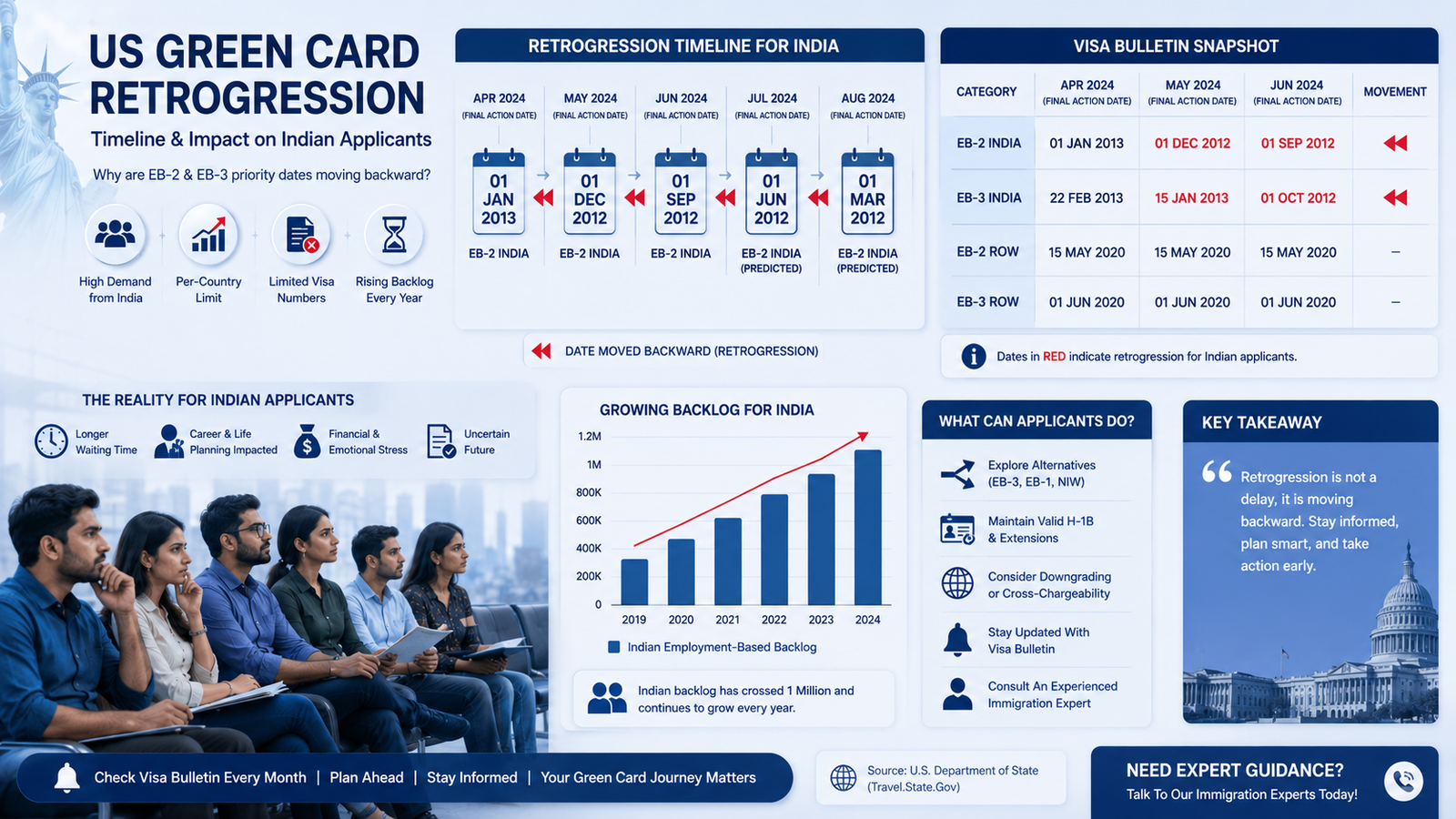
Before we dive into the data, let us make sure we are speaking the same language. The US immigration system allocates a limited number of employment-based green cards each fiscal year — approximately 140,000 visas annually, spread across five preference categories (EB-1 through EB-5).
The problem? Demand from Indian professionals alone vastly exceeds this entire pool. And because of a 7% per-country cap, India gets no more than roughly 9,800 of those 140,000 visas per year — regardless of how many qualified Indian applicants are waiting.
[H3] Priority Date: Your Place in Line
When your employer files a PERM Labour Certification on your behalf, you receive a priority date — think of it as the date you officially joined the green card queue. Only when the monthly Visa Bulletin's cutoff date reaches or passes your priority date can you move forward in the process.
[H3] Final Action Date vs. Filing Date — What Is the Difference?
Final Action Date (Chart A): This is the date that must pass before USCIS can approve your green card. It is the definitive benchmark that determines when you actually receive your permanent residency.
Dates for Filing (Chart B): This is an earlier date that sometimes allows you to submit your I-485 Adjustment of Status application — even if final approval is not yet possible. Filing early locks in your place and allows you to get an Employment Authorization Document (EAD) and Advance Parole travel document, reducing your dependency on H1B status.
Retrogression occurs when the Final Action Date moves backward — meaning the government has hit or is approaching the annual cap for a country-category combination. Applicants whose dates were previously current suddenly become ineligible again. The wait restarts. And for Indians, this happens with painful, recurring frequency.
June 2026 Visa Bulletin: What the Numbers Actually Say
⚠️ OFFICIAL STATE DEPARTMENT WARNING: The June 2026 Visa Bulletin states: "Further retrogressions, or making the categories 'unavailable,' may be necessary in the coming months if India's pro-rated limits in the EB-1 or EB-2 categories are reached before the fiscal year ends." (Source: travel.state.gov — June 2026 Visa Bulletin)
Here is exactly what changed when the June 2026 bulletin was released:
June 2026 Final Action Dates — India (Employment-Based Categories)
Category | May 2026 Date | June 2026 Date | Change
EB-1 India | April 1, 2023 | December 15, 2022 | ▼ Retrogressed 3.5 months
EB-2 India | July 15, 2014 | September 1, 2013 | ▼ Retrogressed 10+ months
EB-3 India (Prof. & Skilled) | November 15, 2013 | December 15, 2013 | ▲ Advanced 1 month
EB-1 China | April 1, 2023 | April 1, 2023 | No Change
EB-2 China | September 1, 2021 | September 1, 2021 | No Change
EB-1 / EB-2 Rest of World | Current | Current | Current
To put this in painful perspective: the EB-2 India Final Action Date is now sitting at September 1, 2013. That means only applicants whose employers filed their PERM before September 2013 — over 12 years ago — are currently eligible for final green card approval.
The State Department has been unusually blunt in the June bulletin, warning that categories could become entirely "unavailable" — meaning no new green cards at all — if demand continues at this pace before September 30, 2026 (the end of the US fiscal year).
Need help understanding what your priority date means for your specific situation? Our immigration guidance team at IndiaWale Abroad is here to help. Book a free consultation at indiawaleabroad.com/contact
━━━━━━━━━━━━━━━━━━━━━━━━━━━━━━━━━━━━━━━━━━━━━━━━
Why Indians Are Hit the Hardest — and Why It Will Not Change on Its Own
━━━━━━━━━━━━━━━━━━━━━━━━━━━━━━━━━━━━━━━━━━━━━━━
If you feel like the US immigration system is especially unfair to Indians, you are not wrong. And understanding why is the first step to planning your way through it.
The 7% Per-Country Cap: A Rule That Punishes Success
Under current US law, no single country can receive more than 7% of all employment-based green cards in a fiscal year. This means India — a country of 1.4 billion people that sends a disproportionate number of skilled professionals to the US — is subject to the same annual green card limit as Luxembourg, with a population of fewer than 700,000.
The result? India gets approximately 9,800 EB green cards per year despite generating over 50% of employment-based green card demand. The math simply does not work. There are more Indians waiting in the EB-2 category alone than there are EB visas available for India over the next 85+ years at the current rate.
The Tech Sector Pipeline Effect
India has been the dominant source of H1B visa holders for decades. When hundreds of thousands of Indian engineers enter the US workforce on H1B status and then apply for green cards through EB-2 or EB-3 pathways, they all flow into the same narrow country-specific pipeline. Every year, more people join the queue than leave it through green card approvals.
The Spillover Mirage Is Over
In some years, when other countries underuse their visa allocations, those unused numbers "spill over" to oversubscribed countries like India — temporarily accelerating movement. But in 2026, that window has effectively closed. Demand from previously under-utilising countries has normalised, and there are no surplus visa numbers left for India to benefit from.
"An Indian professional who files for an EB-2 green card today faces an estimated wait of approximately 12 years. For EB-3, it is 13 or more years. The same process takes Canada approximately 6 months."
EB-2 vs. EB-3 for Indians in 2026: Which Path Makes More Sense?
This is the question every Indian applicant and their immigration attorney wrestles with. There is no single universal answer — but here is a comprehensive breakdown to help you think it through.
EB-2 vs. EB-3 India — Full Comparison Table
Factor | EB-2 India | EB-3 India
Current Final Action Date (June 2026) | September 1, 2013 | December 15, 2013
Estimated wait for new filers | ~12 years | ~13 years
Education requirement | Advanced degree (Master's or Bachelor's + 5 yrs exp) | Bachelor's degree or 2 yrs skilled work experience
Typical salary / role level | Higher — senior and specialist roles | Broader — includes skilled workers
PERM required? | Yes (except NIW) | Yes
PERM timeline | 16–21 months typically | 16–21 months typically
NIW (self-petition) option? | Yes — no employer needed | No
EB-1A upgrade potential? | More likely for senior profiles | Less common
Downgrade / interfile option? | Can downgrade to EB-3 if beneficial | N/A — already EB-3
June 2026 movement | Retrogressed 10+ months ▼ | Advanced 1 month ▲
Best suited for | Master's/PhD holders, senior engineers, researchers, NIW candidates | Bachelor's holders, broader workforce, those prioritising early filing
The key insight for 2026: The gap between EB-2 and EB-3 India dates has narrowed dramatically. In the June bulletin, EB-3 India (December 15, 2013) is actually ahead of EB-2 India (September 1, 2013). This makes interfiling or downgrading from EB-2 to EB-3 a legitimately attractive strategy for many applicants — something that was rarely recommended even a few years ago.
What EB-2 and EB-3 Indians Should Actually Expect Next
Let us be honest about the landscape. Here is a realistic outlook based on current data, State Department warnings, and historical patterns.
Before September 30, 2026 — End of Fiscal Year
The State Department has explicitly warned that further retrogression — or even making EB-1 and EB-2 India "unavailable" — is possible before the fiscal year ends. This is not speculative. It is a formal warning in the official bulletin. If India's pro-rated limits are exhausted, new green card approvals in those categories could halt entirely until October 1, 2026.
October 2026 Onward — FY2027 Reset
The start of a new fiscal year typically brings a meaningful jump forward in priority dates as fresh visa numbers become available. Analysts expect a significant rebound for EB-1 and EB-2 India when FY2027 begins — but how far they move will depend on total demand and any legislative changes during the year.
The Structural Problem Remains
No monthly visa bulletin can fix the underlying issue: the 7% per-country cap, unchanged since 1990. Without Congressional action — which has been proposed many times but has not passed — Indians will continue to face decade-long waits while professionals from most other countries receive their green cards within one to two years.
Policy and Political Factors in 2026
The current political environment makes legislative change uncertain. While tech industry lobbying continues to push for per-country cap reforms, no bill has come close to passing in this Congress. Indian applicants should plan their strategies assuming the structural backlog remains, with incremental monthly movements and occasional retrogressions.
7 Strategies Indian Applicants Should Seriously Consider Right Now
Waiting passively is the least effective strategy available to you. Here are the concrete moves immigration attorneys are actively discussing with Indian applicants in 2026.
1. Interfile or Downgrade from EB-2 to EB-3
If your EB-3 date is ahead of your EB-2 date — which it is in June 2026 — and you already have an approved I-140 in EB-2, you may be able to file an EB-3 I-140 and interfile. This could move your green card forward by a few critical months. Consult an immigration attorney immediately to assess your specific case.
2. File I-485 Early Using Chart B (Dates for Filing)
When USCIS authorises use of the Dates for Filing chart, applicants with earlier priority dates can submit their I-485 Adjustment of Status application. This does not mean immediate approval — but it gets your application in the system, makes you eligible for an Employment Authorization Document (EAD), and gives you an Advance Parole travel document — significantly reducing your dependence on H1B status.
3. Explore EB-1A — Extraordinary Ability
If your profile is strong — multiple publications, patents, industry awards, significant leadership recognition, or media coverage of your work — EB-1A may be worth exploring. It currently has no per-country backlog and remains current for India. The standard is high, but for those who qualify, it is the fastest pathway available in the employment-based system.
4. Consider EB-2 NIW — National Interest Waiver
If you work in a field with national importance — healthcare, clean energy, AI research, biotech, defence technology, or public interest sectors — an NIW self-petition eliminates the need for PERM and employer sponsorship. You still sit in the India EB-2 queue, but you gain full independence from your employer, which is a significant benefit in itself.
5. Use Cross-Chargeability If You Have a Mixed-Nationality Marriage
If your spouse was born in a country with a more favourable cutoff date — such as the UK, Germany, Australia, or Singapore — you may be able to use their country of birth for chargeability purposes. This is a powerful and significantly underused strategy for mixed-nationality couples that immigration attorneys often do not raise proactively.
6. Protect Your H1B Status Aggressively
Until your green card is approved, your H1B is your safety net. Make sure your H1B extensions are filed on time, your employer support is stable, and any job changes are handled carefully to protect your I-140 approval and priority date. Under AC21 portability, once your I-140 has been approved for 180+ days and your I-485 is pending, you can change employers without losing your priority date — as long as the new job is in the same or similar occupation.
7. Seriously Evaluate Global Alternatives
Countries like Canada (Express Entry — typically 6 months), Australia (SkillSelect), Germany (EU Blue Card), and the UK (Skilled Worker visa) offer permanent residency timelines measured in months, not decades. For some Indian professionals, the calculus of waiting 12+ years in the US queue versus building a life in another English-speaking country may be shifting. This is not giving up — it is strategic planning.
Thinking through your options? Our team at IndiaWale Abroad can help you evaluate both US and global pathways. Visit indiawaleabroad.com/contact to get started.
Expert Advice: What You Must Do Today
Know your exact priority date and track it every single month. Set a reminder to check the State Department Visa Bulletin the moment it is released (typically around the 10th of each month). Do not rely on news articles alone — always read the primary source at travel.state.gov.
Maintain meticulous documentation. Keep every immigration document organised and accessible — your original PERM filing receipt, I-140 approval notice, all H1B petitions and approvals, and any I-485 filings. These documents are irreplaceable and may need to be produced years down the line.
Understand your employer's obligations and your portability rights. Many Indian professionals do not realise that their employer can withdraw the PERM petition if they leave before the I-140 is approved. Once your I-140 is approved and you have held it for 180+ days, you gain AC21 portability rights — allowing you to change employers without losing your priority date.
Do not make major life decisions based on an assumed green card timeline. The June 2026 bulletin is a sharp reminder of how quickly dates can move backward. Build your financial and personal decisions with the understanding that your green card timeline is a moving target, not a fixed deadline.
Get professional guidance, not just forum advice. Reddit, Quora, and WhatsApp groups are full of well-meaning people sharing their individual experiences — but immigration law is nuanced. A strategy that worked for someone else may not apply to your case. Always consult a qualified immigration attorney before making any major filing decision.
Frequently Asked Questions
What is green card retrogression and why does it happen?
Green card retrogression occurs when the USCIS Visa Bulletin moves the priority date cutoff backward, making previously eligible applicants ineligible again. It happens when demand for green cards in a particular country-category exceeds the annual quota. For India, this happens frequently because the 7% per-country cap limits India to approximately 9,800 employment-based green cards per year — far fewer than the hundreds of thousands of Indian applicants currently waiting.
What happened to EB-2 India in the June 2026 Visa Bulletin?
The June 2026 Visa Bulletin retrogressed the EB-2 India Final Action Date by more than 10 months — moving it backward from July 15, 2014 to September 1, 2013. The US Department of State also formally warned that further retrogression, or the category becoming entirely "unavailable," is possible before the fiscal year ends on September 30, 2026.
How long is the EB-2 India green card wait time in 2026?
New EB-2 India applicants filing in 2026 face an estimated wait of approximately 12 years at current processing rates. This figure can shift based on spillover from other categories or legislative changes, but no significant near-term improvement is expected without Congressional action to reform the per-country cap.
Is EB-3 India better than EB-2 India in 2026?
In June 2026, the EB-3 India Final Action Date (December 15, 2013) is slightly ahead of the EB-2 India date (September 1, 2013). This has led many immigration attorneys to recommend that qualifying applicants consider interfiling or downgrading from EB-2 to EB-3 to gain a few months of advantage. However, this decision depends heavily on your specific qualifications, priority date, and case history — always consult a qualified attorney before making this move.
What is the difference between a Final Action Date and a Filing Date?
The Final Action Date (Chart A) is the date that must pass for USCIS to approve your green card — it determines when you actually receive permanent residency. The Dates for Filing (Chart B) is an earlier date that, when authorised by USCIS, allows you to submit your I-485 Adjustment of Status application. Filing via Chart B enables you to receive an EAD work permit and Advance Parole travel document, even while waiting for final approval.
Can I change jobs while waiting for my green card?
Yes — under the AC21 portability rule, once your I-140 has been approved for at least 180 days and your I-485 is pending, you can change employers without losing your priority date — provided the new job is in the same or a similar occupational category. Changing jobs before the I-140 is approved, or before 180 days have passed, carries more risk and requires careful handling. Always inform your immigration attorney before making any job change.
What is the EB-2 NIW and who qualifies?
The EB-2 National Interest Waiver (NIW) allows qualified individuals to self-petition for a green card without needing an employer sponsor or PERM labour certification. To qualify, your work must be in an area of substantial merit and national importance, you must be well-positioned to advance that work, and the US must benefit from waiving the normal job offer requirement. Researchers, academics, healthcare professionals, engineers in strategic sectors, and some entrepreneurs often qualify. Note that NIW applicants still sit in the India EB-2 queue — there is no expedited processing for NIW petitions.
What happens if EB-2 India becomes "unavailable"?
If a category is declared "unavailable," no new green cards are approved in that category until new visa numbers are released — typically at the start of the next fiscal year on October 1. If you have already filed your I-485, your case remains pending. If you have not yet filed, you must wait. This is why immigration attorneys consistently advise filing I-485 as early as your dates allow, rather than waiting for a more convenient time.
Are there faster green card alternatives for Indian professionals?
Yes. EB-1A (Extraordinary Ability) and EB-1B (Outstanding Researcher) have shorter or no backlogs for India and currently remain available for most applicants who meet the evidentiary standard. Cross-chargeability can help mixed-nationality couples use a spouse's more favourable country of birth. Beyond US options, Canada (Express Entry — typically 6 months), Australia, and Germany offer permanent residency pathways measured in months, not decades, for qualified Indian professionals.
Conclusion: The Wait Is Real — But So Are Your Options
The June 2026 Visa Bulletin is not an anomaly. It is the latest and sharpest expression of a structural crisis that has been building for over three decades in US immigration. The 7% per-country cap, written into law in 1990 when the world looked very different, is producing outcomes that no one who cares about fairness or economic competitiveness can defend.
For the Indian engineer who has been in America for 12 years, raised children here, and built companies and technologies that power the US economy — the green card queue is not a bureaucratic inconvenience. It is an ongoing psychological and financial burden that shapes every major life decision, every job change, every home purchase, and every conversation about the future.
But here is what matters most: passive waiting is not a strategy.
The people who navigate this system best are the ones who stay informed, file early when opportunities arise, understand the interplay between EB-2 and EB-3 options, and work with professionals who know immigration law deeply. Whether that means exploring a downgrade from EB-2 to EB-3, evaluating an NIW petition, filing an I-485 as soon as your dates allow, or seriously considering what life might look like in Canada or Australia — the options are real. They require thought, planning, and in most cases, professional guidance.
You have spent years building a life and a career in America. You deserve a strategy as serious as your ambitions.
CALL TO ACTION
Ready to Take Control of Your Green Card Journey?
Whether you are tracking priority dates, evaluating EB-2 vs EB-3 options, exploring NIW, or considering global alternatives — IndiaWale Abroad's immigration guidance team is here to help Indian professionals make informed, strategic decisions.
👉 Book a Free Consultation: indiawaleabroad.com/contact
👉 Read More Immigration Guides: indiawaleabroad.com/blog
👉 Explore Study Abroad USA: indiawaleabroad.com/study-abroad/usa
SOURCES & REFERENCES
1. US Department of State — June 2026 Visa Bulletin
2. USCIS — Adjustment of Status Filing Charts
3. Fragomen Immigration — June 2026 Visa Bulletin Analysis
https://www.fragomen.com/insights/united-states-june-2026-visa-bulletin
4. WR Immigration — June 2026 Visa Bulletin Commentary



Comments
No approved comments yet. Be the first to comment.